
| Tasty byte-size provocations to refuel your thinking! | Brought to you by:  |
We Are All Global Musicologists Now!
Why?
Why global musicology?1 Most musicologists think we need global musicology because music is global. Yes, music is global. It is everywhere and on the move. Music has always been a peripatetic object, knitted together from criss-crossing boundaries, leaving a meandering trail of encounters across the soundscapes of time. Global musicology reflects this condition as its theme. But the theme is not the reason for global musicology. After all, music has been global for hundreds of years. So the question is: Why global musicology now?
Musicology is global now because musicologists are global now. The reason for global musicology is less about the music than the people; it is not so much thematic as demographic. Today, musicologists are everywhere. We are peripatetic agents in an age of high-speed travel and information transfer, criss-crossing boundaries physically and virtually in a complex interconnected global network. It is people that make musicology global. As products of globalization, we are its very definition.2
Global musicology, then, is not a particular theme but a general condition in which musicologists located in different parts of the world have a unique perspective on the globe. The global in global musicology should simply be a fact—an observation. But this simple fact is also a paradigm shift, a foundational disruption akin to Einstein’s scientific revolution: global musicology is a theory of general relativity. If musicologists are now everywhere, then the space-time of musicology has become relative, depending on where musicologists are on the planet. There is no absolute position from which to fix centers and margins; there is no central perspective or local coordinates to claim. Everything is known differently depending on our location on the curved surface of the globe. Musicological space-time is warped.
Or at least it should be. Musicologists may be everywhere, but musicology is not quite there yet. The movement of musicologists across the globe has outrun the epistemological base, leaving the discipline chasing after its demographic reality. Musicology needs to catch up with its people to be global. Unfortunately, this may never happen; musicology may find itself trapped forever in its time lag instead. Why? because it was never designed for a global community. Today musicologists need “a theory of relativity” to be global, but musicology functions as a “theory of modernity.” And there’s nothing relative about modernity. Ironically, in global musicology, being modern is outmoded.
At first, this might seem counterintuitive. In fact, isn’t modernity the very stuff of global musicology, a theme for endless variations? Almost every piece of research that purports to be global is underwritten by the concept. After all, if modernity is about mobility and interconnection, then global musicology should be the means for mapping its movement in terms of its flows and entanglements across borders. Modernity drives the global and makes the colonial; it is the conceptual motor for the dynamic between centers and peripheries, mainland and borders, the local and global—the binaries that determine so much of our research. If the global is the new musicology, and modernity makes the global, then surely their marriage is meant for such a time as this.
And this is precisely the problem: Modernity works as a brilliant theme for global musicology, but it should not also function as its underlying form. As an epistemology, modernity standardizes the globe from a central viewpoint. It makes a marriage with global relativity a misfit. Unfortunately, this incompatibility is a congenital issue in our discipline.
Musicology was born modern. It came into being in the late nineteenth century at the height of European exceptionalism and essentialism when the notion of Western progress and imperial expansion went hand in hand as instruments for world domination. Modernity reigned supreme at the center of our discipline. If proof were needed, then just look at our name: musicology literally means “the study of music,” just as theology means “the study of God.” For most people outside the discipline, this may seem obvious. Within the field, however, the term has had a much narrower meaning. Musicology is not a general term, but a specific one meaning “Western music history,” which also goes by “historical musicology” (where the idea of the West is so nonchalantly presumed that it can be left unsaid). Musicology divides because modernity divides. It operates as a centralized border control for music, conditioned to categorize everything in “binary form” only. But if the space-time of global musicology is relative, emerging from multiple points of view, then a musicology defined by borders is strangely not global.
Borders fix things. In musicology, modernity controls borders in two fundamental ways:
First, in terms of space, modernity rationalizes the globe as a map, imposing a grid of coordinates to fix borders, determine centers, and chart destinations. Modernity, as a method, is territorial; it draws boundaries and puts a flag on what is foreign. It is all about positions and identities—us and them, victors and victims.
Secondly, in terms of time, modernity is premised on a fundamental divide: modern society needs a border to partition itself from that which is not modern. The premodern world, from which the modern world generates itself, is a past that is either locked away in history and overcome in the present or located elsewhere in the present in a primitive place that has yet to modernize. Either way, time-as-progress needs a border to divide itself from time-as-stasis. What moves forward is defined against what remains backward: that which is new against that which never changes. It is all about historical progress.
These borders—spatial and temporal—form the epistemological challenge posed by modernity for global musicology. If musicology is fundamentally a theory of modernity, then when we thematize modernity and its borders in global musicology, we are confronting our own tacit epistemological foundations. We are looking into a mirror at our ideological blind spot. In this gaze, either we see nothing and perpetuate our blindness, or we squint sideways and modernity becomes an eye-opening self-critique.
Global musicology, then, does not name the union between the global and musicology; rather it is an act of un-naming. When musicology is prefaced by the term global, the whole concept should collapse. The adjective not only unravels the geographic assumption (the West) but also its disciplinary assertion (history). It challenges the ideological foundations of music studies that have divvied up the globe in the crudest disciplinary terms: the West had music history (i.e., progress) and music theory (i.e., a canon that verifies the progress); and the rest was given an ethnography and a natural soundscape. The West takes musicology as its general term, and what’s left needs the dubious prefix “ethno-” to qualify it.3 One has a historical record because it is literate (notation), whereas the other requires sound recording to render its ephemeral yet static nature legible.
These structural divisions match the standard modern/premodern divide used to define modern societies against their Other. And, despite previous attempts to obviate the biases within our discipline, we’ve not been able to overcome the divide because it is ingrained in our institutional structures and methodological framework.4 This puts global musicology in a precarious position. Prefixing the term global to musicology should cause the whole concept to collapse, but in this collision, the opposite could also happen: the modern in musicology may decimate the global, fragmenting global musicology as a thematic subfield that merely signals its virtues while leaving the fundamental divisions of modernity intact. Since modernity is hardwired as the dominant system in musicology, the connection between the musicological and the global may suddenly fuse—and “BANG!”—global musicology fizzles out as a passing trend. Instead of musicology catching up with its people, it would simply pull them back under its control.
Drastic action is required to shock us out of our delusional alliance with modernity if global musicology is to succeed. This demands nothing less than an epistemological intervention that questions the foundation of everything we know in musicology: What if we have never been modern?
This radical intervention is not my idea, but a general one published in 1991 by Bruno Latour in his book We Have Never Been Modern. The modern/premodern identity that defines “us” moderns, Latour explains, is merely a claim—a theoretical “constitution” that does not actually constitute our hybrid practices. An anthropological analysis would easily verify that the we (moderns) do not live by the dualism we espouse and, like any other “premodern” society, mix up what we have separated—the human and non-human, culture and nature, subject and object, politics and science, reason and religion, history and ethnography, and so on. “There has never been a modern world,” declares Latour. The globe is all premodern or, rather, “non modern” or “amodern.”5
And this goes for the modern invention of musicology, too. It is a theoretical constitution that does not actually reflect our hybrid musical practices in everyday life. A glance at our founding constitution, Guido Adler’s “The Scope, Method, and Aim of Musicology” of 1885, will demonstrate the divisions and subdivisions at the inception of the discipline in its modern form. There is no need to read its content, just the optics of the “tabular form” reproduced in figure 1 will do to illustrate the segregation of musicology into specialized compartments.6
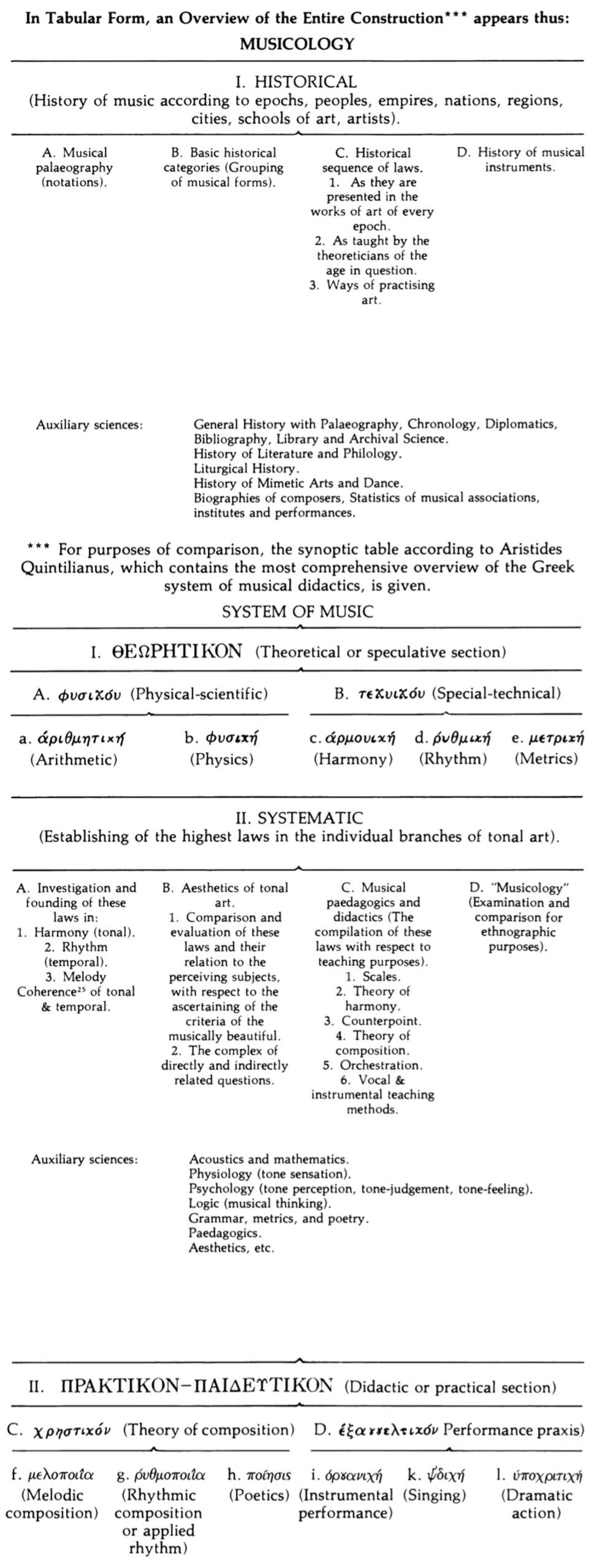
Who lives like this? Historical musicology, in its pursuit of narratives of progress and emancipation, has discarded most music in the world to focus in only one half of the binary oppositions that define modernity—the human not non-human, culture not nature, subject not object, reason not religion, and so on. Ethnomusicology dutifully follows behind to mop up what’s left in the other half, reinforcing the binary opposition. The solution is not to say we are “all (ethno)musicologists now” (as in Nicholas Cook’s reassessment of musicology) or “all musicologists now” (as in Stephen Amico’s critique of ethnomusicology).7 The “all” declared in these “re-constitutions” simply depends on which side of the same coin you wish to critique or subsume. But you don’t win in global musicology by making a division a zero-sum game. That is precisely how modernity works. Boundaries take sides.
Instead, global musicology needs to be “a-modern.” This is a musicology in which the global is decoupled from the constructs of modernity.8 After all, what’s the point of trumpeting a global theme if the epistemology remains Western? But if we have never been modern, then we can ditch the divisive strictures and mix things up a bit like everybody else on the planet. Adler’s tidy table of contents along with modernity’s disciplinary and geographical divisions can be scrambled into an indifferent mixture. It is not that everything is the same in this mix; rather, everything is distinctively relative. Difference only stands out as a relation if the background is indifferent.
How?
How do we do this? If you recall, modernity divides musicology in two fundamental ways: spatially, as a map, and temporally, as historical progress. So to decouple global musicology from modernity, we need to perform two tasks:
- Throw away the map, and
- Stop historical progress.
Task 1: It is hard to throw away the map. After all, the globe is on it. And the modern world has been reliant on cartography to get itself to go places. How could global musicology as an emerging movement possibly survive, let alone arrive anywhere, without a map? So instead of letting go of the map, global musicology has been trying to chart the world. This has given rise to the dubious notion that global musicology is a matter of adding more regions to its cause, which is both methodologically arbitrary because the other is always just an-other in a random series, and pedagogically impossible because coverage requires the endless inclusion of “others.”9 From this perspective, global musicology is a territorial enterprise based on the erroneous belief that its fulfillment lies in the future. The task is to finish coloring the map. The job, then, for savvy music scholars is to acquire new regions as their secondary research area to secure the future of musicology (and to put their careers on the map!).
This is all very heroic, and the scholarship can often be brilliant. But in trying to get our fingers around the globe, we risk reducing it, repeating the instrumental relation to the “other” where we simply control, mine, and use its resources for familiar purposes. Global musicology would just reassert the discursive power to make the “other” knowable and now global.10 It would resemble past attempts to write a universal or world history of music—as if we could know it all once we’ve mapped it all.11
But the global exists in the present and not in the future because musicologists are already everywhere. There is nothing to add. No mapping is necessary because we are already inhabitants of the planet. As musicologists across the globe, we determine the global content by being where we are. And it is precisely because there is nothing to map that we are no longer in a position to know it all: global musicology emerges from the relation between situated particulars in an infinitely complex system that we cannot grasp. It is akin to what Timothy Morton calls a “hyperobject,” an entity so big that it is beyond our reach, and can be known only in part as something that emerges across time and space through endless transformative interactions on the ground.12 It is like a swirling weather system, something defined more as an ecology than a cartography. After all, on the surface of the globe, we are all decentered inhabitants in different positions, each one with a unique coordinate, with diverse perspectives, narratives, definitions, strategies, and standards, all swirling at different rates across the planet. It is a system where everyone is simultaneously foreign to each other and native within their own vicinity; each position is both central locally and parochial when viewed from elsewhere.13 Agency is neither unidirectional nor bidirectional but blandly multidirectional.14
If the definition of global musicology is dependent on where you are, then you don’t need to be some well-traveled-cosmopolitan-world-citizen scholar to count. You don’t have to acquire another land mass for your research to be relevant. There’s no need to change your subject, however “local” you might deem it to be. And since everyone is already in place across the globe, you don’t need to position your identity because what is uniquely you emerges by being in relation to an alterity that cannot be fully known. The global is the non-identical part of the hyperobject that includes you yet always recedes from your grasp. The only qualification is to be exactly where you are as an inhabitant, open to the inhabitants around you—a being-in-relation. There is nothing to do but everything to be. So the question is: if there is nothing to do, what then is global musicology?
Global musicology is about being before doing. It is first an awareness, a recognition, a responsibility, a listening, a relation, a value, a commitment, a posture of the mind. Unfortunately, this is not how academia works. It is all about doing! And this brings us to the second task.
Task 2: Stop historical progress. In academia, we are all crazy, modern people driven by institutions obsessed with rankings. Just “being” is hardly an option. We are about progress and productivity. In the marriage between musicology and modernity, the only commitment is “I do!” We need to push research forward in order to demarcate the border that keeps us on the right side of modernity. As academic imperialists, we need to make history; we get our hands on the essence of things in an act of epistemological and material conquest, then bend them to our will. And now that global musicology is trending as the next big thing, we need to acquire the globe to be relevant. At times, global musicology feels like it is in overdrive: the globe requires multitasking, its complex relations need hyperattention, and its world-wide operations demand overachievers. No doubt, it produces good work. But as much as I admire the pyrotechnics in so many globally themed publications, we need to step away from the representation of the global as a figure and return to the ground. So let’s stop making history progress in our research. Stay still. Look around. Otherwise, our frenetic labor will prevent us from marveling at the way things are, and from realizing that global musicology has already been occurring in miraculous ways we hardly know. We don’t manufacture global musicology as an act of the will; it happens.15 Nothing needs doing.16 All it takes is a slight shift of perspective.
The whole point of our global enterprise is to redistribute worth according to the laws of general relativity. Having no centers or margins means that everyone across the globe is differently yet equally and already relevant, whether you are in Bogota, Boston, Beijing, Brussels, or Bobo-Dioulasso. Global musicology is not here to change you but to release you as you are. It should be a liberation, not an added burden. In global musicology, you don’t need to make historical progress. What you do already counts as long as there is a willingness to participate, from your location on the globe, in the cloud of unknowing that is the hyperobject we call musicology. If this sounds a bit too nebulous and mystical, then think of the cloud as a heap. When is a heap a heap? Who knows? But at some point, a growing clump of particles interacting with each other will be a tipping point, and the particles become part of something bigger that will change their definition. Did the particle change itself? Did it do anything different? Is one particle necessarily more important than another? No. And yet something big happened. So some seemingly “insignificant” scholar, working in some “obscure corner” of the globe on some “local” aspect of music, is just as relevant if not more global than some fancy academic at the “center” of the musicological map with all the resources at hand to master a musicology of multiple regions. Virtuosity is not a virtue in global musicology. Particles need only connect, and who knows which one will be the tipping point that makes the critical mass critical.
This is why it is best to think of global musicology as an ecology that embraces all aspects of musicology as an intricate and interconnected whole where the focus is not on the faces of prominent academics but the interfaces between academics. In this regard, a certain Daniel K. L. Chua pontificating on global musicology is not significant or progressive, he’s just loud. It is the “in-between-ness” of things that is the critical mass for global musicology, in the spaces inhabited by scholars who listen to alterity, who lower the cost of entry, who connect distant people, who entertain strangers, who suspend judgement, who care for their locality, and who build bridges. These people are often unseen, since there is no need to flag your existence if you already embedded in an ecology; you vanish as part of everything that surrounds you.
When global musicologists finally inhabit a global epistemology, our discipline will be transparent. The global will appear not as an opacity of themes but a clarity of thought that will illuminate the motivic network within the hyperobject we inhabit. The challenge for global musicology now is to foster an “a-modern” environment for that epistemology to emerge. This will take time, not progress. It will take people, not identities. It will take partnerships, not positions. It will co-present rather than re-present. It will be a “slow musicology” that bypasses the speed of modernity by having no trends, no up-to-date methods, no cutting-edge standards, and no critical themes—all of which are generated by “modern” powers bent on upholding modernity’s divides.
Where?
Where does this leave modernity? A globality without modernity does not mean that modernity does not exist. Canceling modernity would merely turn a blind eye to a blind spot that has been revealed. Modernity remains, but it is no longer synonymous with the global. Modernity does not make the global, and the global does not need to be modern. In other words, modernity no longer dominates as the regulatory principle; it is merely one particular epistemology thrown into the mix as part of the theory of relativity. It is not canceled. “Modern” thought still has a significant role to play. But its universal claims are suspended in “quotation marks” and unmasked as a construct (or, in Latour’s terms, a constitution) that should no longer control our epistemological borders.
This is not a matter of neutralizing modernity, as if by turning it into a construct, modernity is now fictional. It is still very real in that it has conditioned how we operate, including in our own discipline. It is still a theme that we must pursue in our scholarship. As a construct, it has bent our discourses, fashioned our perception of the world, forged our institutions, colonized our music, and formed our identities. And it will continue to do so. There is nothing “neutral” about it. But our lived reality is not modernity, for we have never been modern. Rather, there is a gap between the reality we live and the epistemological system we believe in—a gap between the real and the ideal (albeit not an ideal ideal).
So think of modernity as an ideal “up there,” positioned as a satellite that oversees the globe. It orbits over us as a cartographical ideology exerting its power. Musicology (in the traditional sense) also belongs “up there” as a modern construct that divides and maps the world. In contrast, the “a-modern” world is the lived reality on the ground that does not align with the divisive constructs “up there.” Similarly, a global musicology defined by inhabitants on the ground is “a-modern.” It belongs “down here.” It is an emergent musicology of mixtures where the divisions are broken up into complex, indifferent interactions.
Without this gap between the real and the ideal, there is no critical foothold for resistance or creative leverage for change. Change, of course, will be hard. The odds are overwhelming: how can an emerging global musicology overcome a totalizing global modernity? Not with an equal and opposite force for sure, which, in any case, would only replicate the very system it opposes. But at least there is a gap. It takes only a few particles in a hairline fracture to create sufficient mass to crack the totality open. And these particles, however small, are already operative across the world.17 The challenge for global musicology is to negotiate the slippage between the real and ideal in order to keep our discipline grounded: it requires the global to be an everyday epistemology based on our lived reality “down here.” In this mundane, indifferent, emergent mixture, there is no need to take sides, as if our discipline is still determined by the abstract divisions “up there”; we are neither “all ethnomusicologists now” nor “all musicologists now” because these are ideological constructs. By keeping things down to earth, we can all be global musicologists now … because, whether we realize it or not, we really are.18

References
- Ideally, this Brainfood provocation should be read as an addendum to and an amplification of the Brainfood video, Daniel K. L. Chua, “Global Musicology,” Musicological Brainfood 6, no. 2 (2022), and its accompanying article, Daniel K. L. Chua, “Global Musicology: A Keynote Without A Key,” Acta Musicologica 94, no. 1 (2022): 109–26. It is put together from various ingredients: a talk on music theory and analysis for the keynote panel, Dialogues Between Musicology and Ethnomusicology in the Contexts of East Asia and Beyond, at the 8th Biennial Conference of the IMS East Asia Regional Association, Nanning (CN), September 2025; a keynote lecture, “On the Borderlands of Global Musicology,” given at the Balzan Symposium “Sonic Border Passages in the Making of Chinese Modernity” at the University of Chicago Francis and Rose Yuen Campus in Hong Kong (HK), December 2025; a keynote lecture, “Interrogating Global Musical Modernities and Local Agency” given at the “Global Musical Modernities and Local Agency” conference at the University of Toronto (CA), May 2026; and from a forthcoming chapter in The Oxford Handbook of Global Music History.
- Global is an ambiguous word at best. It can mean many things. At its worst, it denotes a totalizing system with totalitarian overtones. Unless we’d like global musicology to resemble a multinational corporation dominating the world as a single brand, we should take advantage of the term’s ambiguity and counter this definition with an alternative meaning for global in musicology. Of course, this is not ideal either: the term should really be replaced. But it’s tricky: global remains as a central term not because it is right (it is clearly a mess) but because other terms are already spoken for. World could work and would nicely parallel other disciplines (such as world literature), but unfortunately the term has been commercialized as world music which is the culture industry’s brand for exoticizing the other for consumption. Other adjectives brewing as possible qualifiers over the last decade are equally problematic: international is too corporate, universal too absolute, post-colonial too one-sided, minority too marginal, cultural too civilizing, multicultural too disparate, cosmopolitan too privileged, comparative too suspect, collaborative too bland. A “just-right” redefinition of global is none of the above. Regarding all the messy pros and cons of these terms (and many more) see, e.g., Nicholas Cook, “Introduction,” in Perpetual Encounter: Globalisation, Cosmopolitanism, and Acculturation in Music, ed. Bianca Ţiplea Temeș et al. (Cluj: MediaMusic, 2024), 34–56; Christian Utz, Musical Composition in the Context of Globalization: New Perspectives on Music History and the 20th and 21st Century, trans. Laurence Sinclair Willis (Bielefeld: transcript, 2021), 25–74; Martin Stokes, “Notes and Queries on ‘Global Music History,’” in Studies on a Global History of Music, ed. Reinhard Strohm (London: Routledge, 2018), 3–17; Nicola Spakowski, “East Asia in a Global Historical Perspective—Approaches and Challenges,” in Studies on a Global History of Music, ed. Strohm, 220–38; Sarah Collins and Dana Gooley, “Music and the New Cosmopolitanism: Problems and Possibilities,” The Musical Quarterly 99, no. 2 (2016): 139–65; Dinko Fabris, “Musicologists Without Borders: Exploring the State of Musicology in Difficult Areas of the Planet,” Musicological Brainfood 7, no. 1 (2023); Reinhard Strohm, “Tradition, Heritage, History: A View on Language,” Musicological Brainfood 2, no. 1 (2018); Björn Heile, Musical Modernism in Global Perspective: Entangled Histories on a Shared Planet (Cambridge: Cambridge University Press, 2024), 7–18; Tobias Janz and Chien-Chang Yang, “Introduction: Musicology, Musical Modernity, and the Challenges of Entangled History,” in Decentering Musical Modernity: Perspectives on East Asian and European Music History, ed. Janz and Yang (Bielefeld: transcript, 2019), 9–40.
- See Stephen Amico, “’We Are All Musicologists Now’; or, The End of Ethnomusicology,” Journal of Musicology 37, no. 1 (2020): 1–32.
- In this regard, the frequent use of global music history instead of global musicology as the alternative go-to term for the emerging movement is problematic, since by privileging history it remains embedded in the ideological assumptions the global is meant to disrupt. See Chua, “Global Musicology: A Keynote,” where I redefine musicology as “the study of music.” The global makes the study of music unbounded in terms of its disciplinary approach. Of course, this includes history, but it neither privileges it nor its divisive powers in segregating the study of music into discrete subdisciplines.
- Bruno Latour, We Have Never Been Modern, trans. Catherine Porter (Cambridge MA: Harvard University Press, 1993), 47.
- See Guido Adler, “Umfang, Methode und Ziel der Musikwissenschaft,” Vierteljahrsschrift für Musikwissenschaft 1 (1885): 5–20. The translation and the image of the table are from Erica Mugglestone and Guido Adler, “Guido Adler’s ‘The Scope, Method, and Aim of Musicology’ (1885): An English Translation with an Historico-Analytical Commentary,” Yearbook for Traditional Music 13 (1981): 14–15.
- See Nicholas Cook, “We Are All (Ethno)Musicologists Now,” in The New (Ethno)Musicologies, ed. Henry Stobart (Langham, MD: Scarecrow Press, 2008), 48–70; Amico, “‘We Are All Musicologists Now.’”
- This decoupling has some similarities with Walter D. Mignolo’s influential concept of “epistemic decolonization” and the need to delink decoloniality from dominant Western knowledge systems and, instead, promote alternative epistemologies suppressed by colonial rule. Mignolo’s emphasis on an epistemic understanding modernity is insightful, but his analyses often result in strategies that are contrary to what I have outlined in this article for global musicology. I am less convinced by Mignolo’s tendency to conflate modernity with coloniality and confine colonialism to European epistemology, creating a divide that promotes “border thinking.” Europe does not have a monopoly on colonialism, and modernity (let alone the global) cannot simply be reduced to a colonial project. Essentializing, demonizing, and canceling Eurocentric epistemology is not the answer but a reversal that merely reproduces the same repressive forces from the other side. Instead, Western epistemology, in my view, needs to be balanced or mixed within an indifferent relative space where various epistemologies can co-exist in their complexity. See Walter D. Mignolo, The Darker Side of Western Modernity: Global Futures, Decolonial Options (Durham, NC: Duke University Press, 2011); Local Histories/Global Designs: Coloniality, Subaltern Knowledges, and Border Thinking (Princeton, NJ: Princeton University Press, 2012).
- Tamara Levitz seems to understand global musicology in this way and has (understandably) opted out. See Tamara Levitz, “Why I Don’t Teach Global Music History,” Journal of Music History Pedagogy 13, no. 1 (2023): 118–37.
- See, e.g., Georgina Born and David Hesmondhalgh, “Introduction: On Difference, Representation, and Difference in Music,” in Western Music and Its Other: On Difference, Representation, and Difference in Music (Berkeley: University of California Press, 2000), 8.
- See Bruno Nettl’s list of such histories in “On World Music as a Concept in the History of Music Scholarship,” in The Cambridge History of World Music, ed. Philip V. Bohlman (Cambridge: Cambridge University Press 2013), 70–91; also see Janz and Yang, “Introduction,” 12–16.
- Timothy Morton, Hyperobjects: Ecology and Philosophy After the End of the World (Minneapolis: University of Minnesota Press, 2013).
- Dipesh Chakrabarty notion of “provincializing Europe” can be a partial model here: we need “provincialized” perspectives from all regions to create an indifferent space for global musicology to develop. See Dipesh Chakrabarty, Provincializing Europe: Postcolonial Thought and Historical Difference (Princeton, NJ: Princeton University Press, 2000). I elaborate on an epistemology of indifference in a forthcoming chapter, “Finding the Way Towards a Global Music History,” in The Oxford Handbook of Global Music History, ed. Olivia Bloechl et al. (New York: Oxford University Press, forthcoming).
- On bi-directionality and multi-directionality, see Björn Heile, Musical Modernism in Global Perspective: Entangled Histories on a Shared Planet (Cambridge: Cambridge University Press, 2024), 17.
- This is not wishful thinking. When I was president of the IMS, I had the privilege of traveling to various parts of the world and witnessed global musicology being made in situ long before the term was trending; see my report “Corona Musicologica,” IMS Newsletter 7, no. 1 (2020): 3–5. Of course, it is still happening; we just need to recognize it.
- The idea of non-action here is inspired by the Dao De Jing which is not about passively doing nothing but actively doing nothing. On the Dao as a different but complementary epistemology for current work in global musicology, see my forthcoming chapter “Finding the Way” in The Oxford Handbook of Global Music History.
- Such particles are what Theodor W. Adorno would call the “non-identical”—concrete particulars that resist the totality and cannot be subsumed by the totality, preserving the possibility of freedom. Adorno hears these qualities in Beethoven’s late style; see Daniel K. L. Chua, Beethoven and Freedom (New York: Oxford University Press, 2017), 107–87.
- This is not an appeal to change the name of our discipline to global musicology—it is just a placeholder. My preferred name for our discipline is just musicology, meaning “the study of music” (where the global reach is already assumed). The fact that we are global now warrants a redefinition of our name, otherwise our discipline will be a misnomer.
The article makes a compelling case that globalization has dissolved the boundary between Western art music and world music in practice, if not yet in pedagogy. As an applied ethnomusicologist and teacher working on Ndebele performance practices in Zimbabwe, I found “We Are All Global Musicologists Now” very timely. The push for reflexive, collaborative methods aligns with Zimbabwe’s Education 5.0, which requires heritage-based innovation and community service. One area I’d like to see expanded is how institutions in the Global South can lead this shift, rather than only being included in Northern frameworks. The article’s argument that global musicology is now the default resonates with our experience: students and communities are already engaging with music across borders, and our role is to provide ethical, reflexive frameworks for that engagement. I appreciate the call to move beyond the ‘world music’ module model and integrate global repertoires into core teaching.